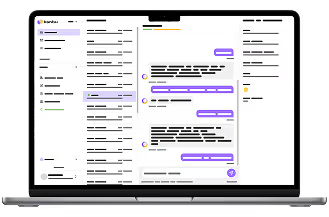
AI assistant for manufacturing & hardware
I make technical specifications, manuals and service procedures accessible to customers and colleagues — even thousands of pages of them. I explain parameters, help assess compatibility and prepare an enquiry or service request through a connected system.
Typical pain
Sales repeats the same parameter and compatibility explanations, while service requests get lost in email. Generic chatbots invent technical data that doesn't match the datasheet.
- Same questions on capacity, dimensions, and compatibility on repeat
- Datasheets in PDF the customer doesn't read or understand
- Service requests without serial number and fault description
- Sales spends time on questions that could be self-serve
What I handle
- Explain capacity, dimensions, and limits from spec sheets with citations
- Compatibility, install constraints, and certifications
- Warranties, service intervals, and maintenance FAQ
- Compare models within a product line
- Quote or consult via in-chat form
- Service ticket via API or handoff to sales
Outcomes to expect
Technical answers only from approved datasheets — no invented specs.
Self-serve clears common selection and compatibility questions without sales.
Service gets a structured ticket with serial number and fault description.
A typical conversation
I understand the application
Where the device will be used, operating conditions, and constraints — no generic tips.
I explain the parameters
From approved datasheets and install guides — with citations. No invented marketing claims.
I compare or verify
I recommend a model from the line, verify compatibility, or check spare-part availability via API.
I move to sales or service
Quote form, service ticket, or specialist handoff with full context.
Concrete scenarios
“Does this model work in our hall?”
I learn operating conditions (temperature, humidity, load), compare specs from the datasheet, and recommend a fit — citing limits. Complex projects go to sales.
Ordering a spare part
Form (serial number, part type) + compatibility check from the spec sheet. Ticket in the service system via API or handoff to a technician.
Warranty service after install
Citation from warranty terms + form (install date, fault description, photos). Service escalation with full chat history.
“Where is the filter-change SOP?”
I find the SOP / manual in the knowledge base, cite the exact steps, and link the PDF. If no approved procedure exists, I escalate to the supervisor.
A technician calls about a spare part
A field technician reads out a serial number and describes the fault. I verify compatibility from the spec sheet and open a service ticket — hands stay on the equipment.
A buyer compares specs over the phone
Walking the production floor, a buyer needs to know which model meets the required output. Over the phone I read out a spec comparison from the technical documentation, no desk required.
What it looks like in practice
Concrete examples of conversations with the assistant in this industry.
Recommends a suitable device based on technical parameters and use case.
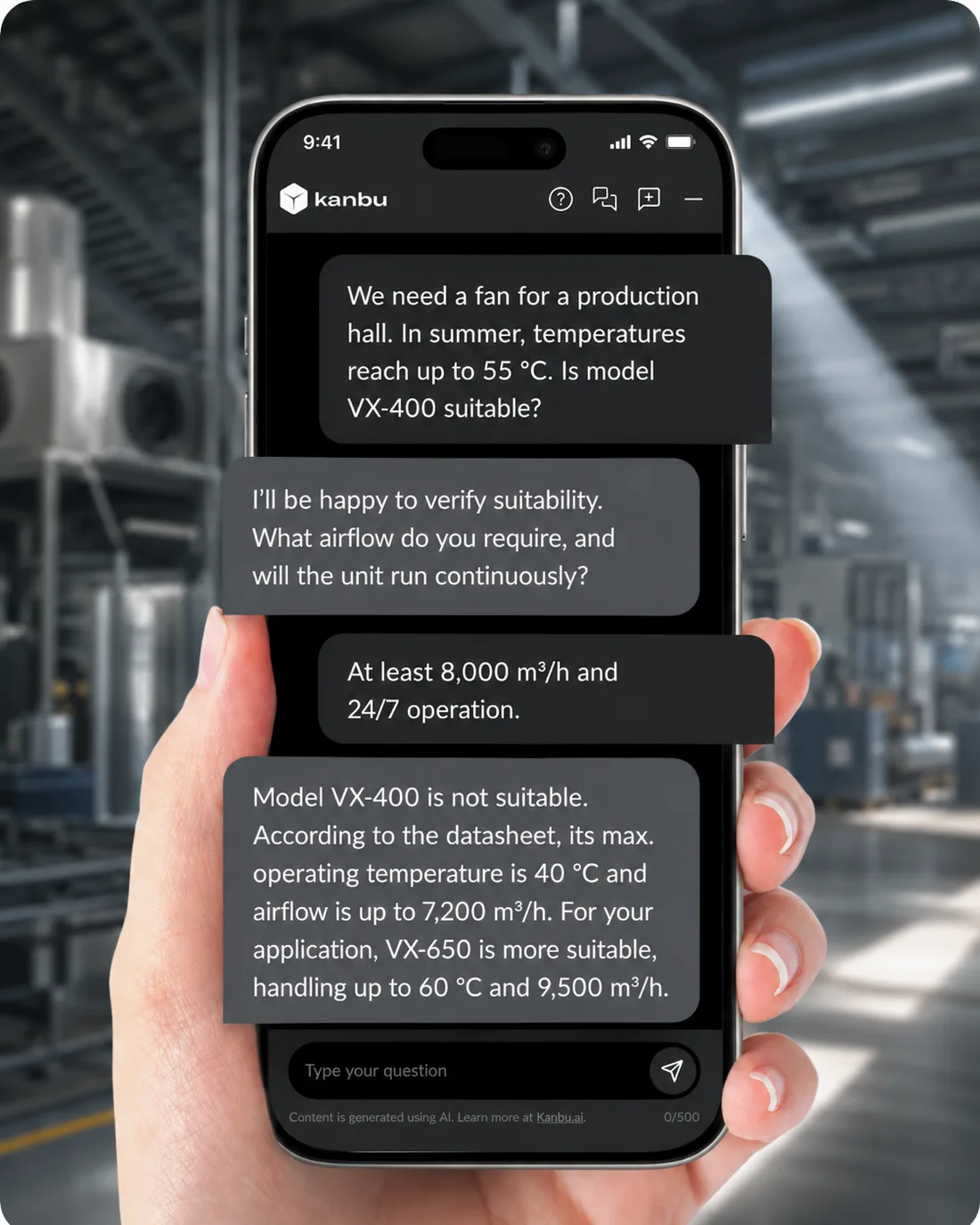
Device selection by parameters
Recommends a suitable device based on technical parameters and use case.
Checks spare-part compatibility and availability.
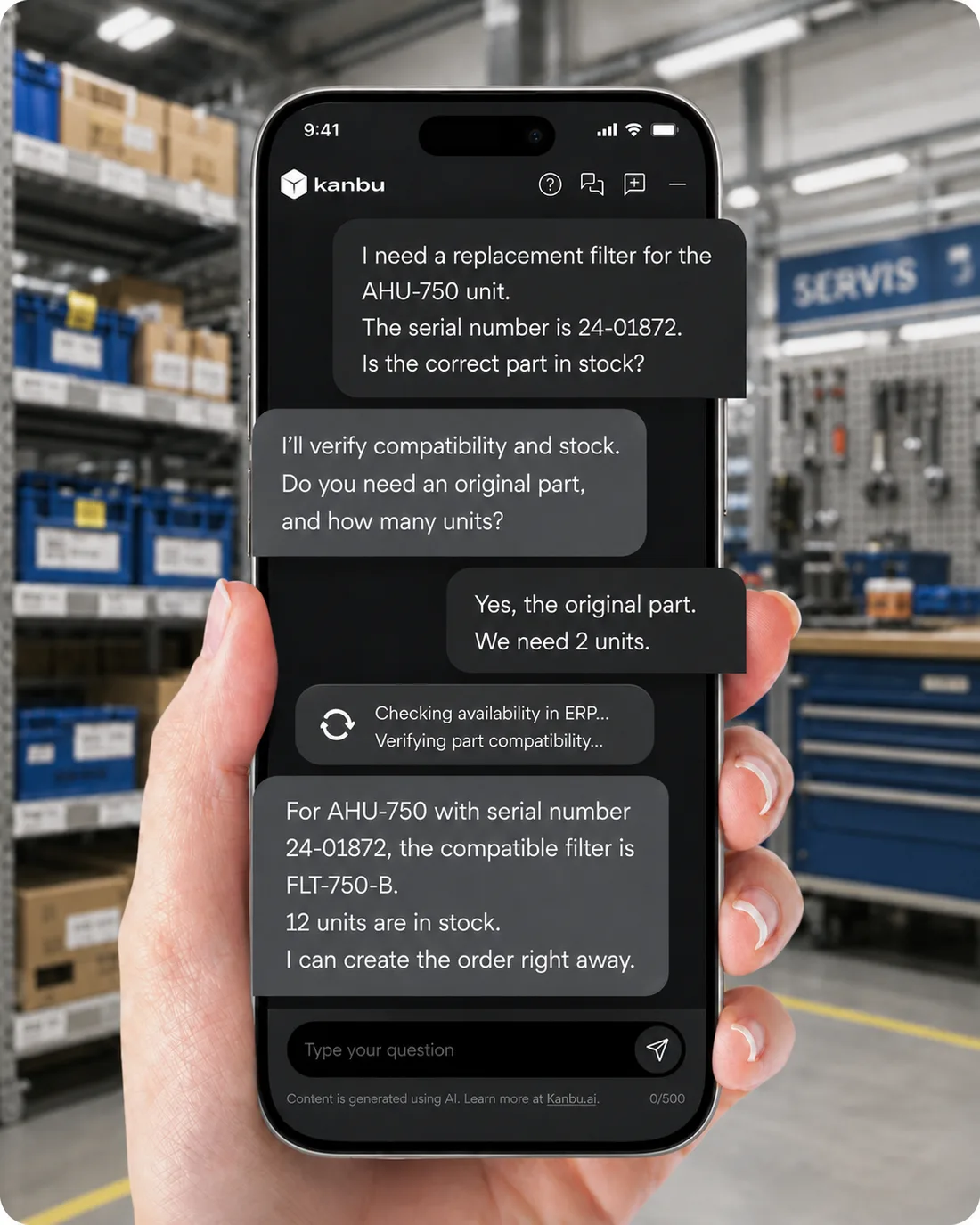
Spare parts and availability
Checks spare-part compatibility and availability.
Collects the serial number and fault symptoms, creates a service request and hands it over to a technician.
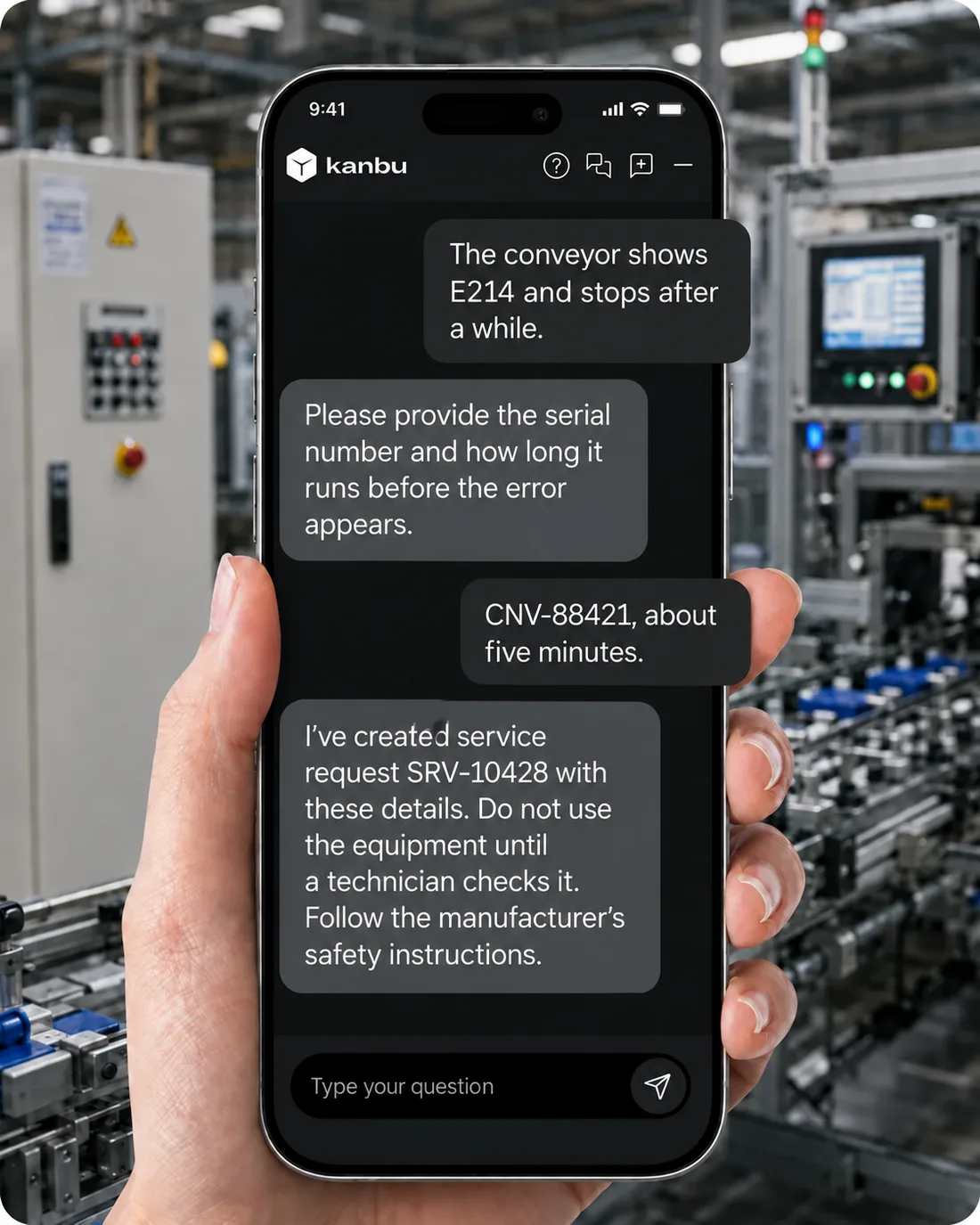
Guided troubleshooting
Collects the serial number and fault symptoms, creates a service request and hands it over to a technician.
Verifies compatibility and prerequisites before installation.
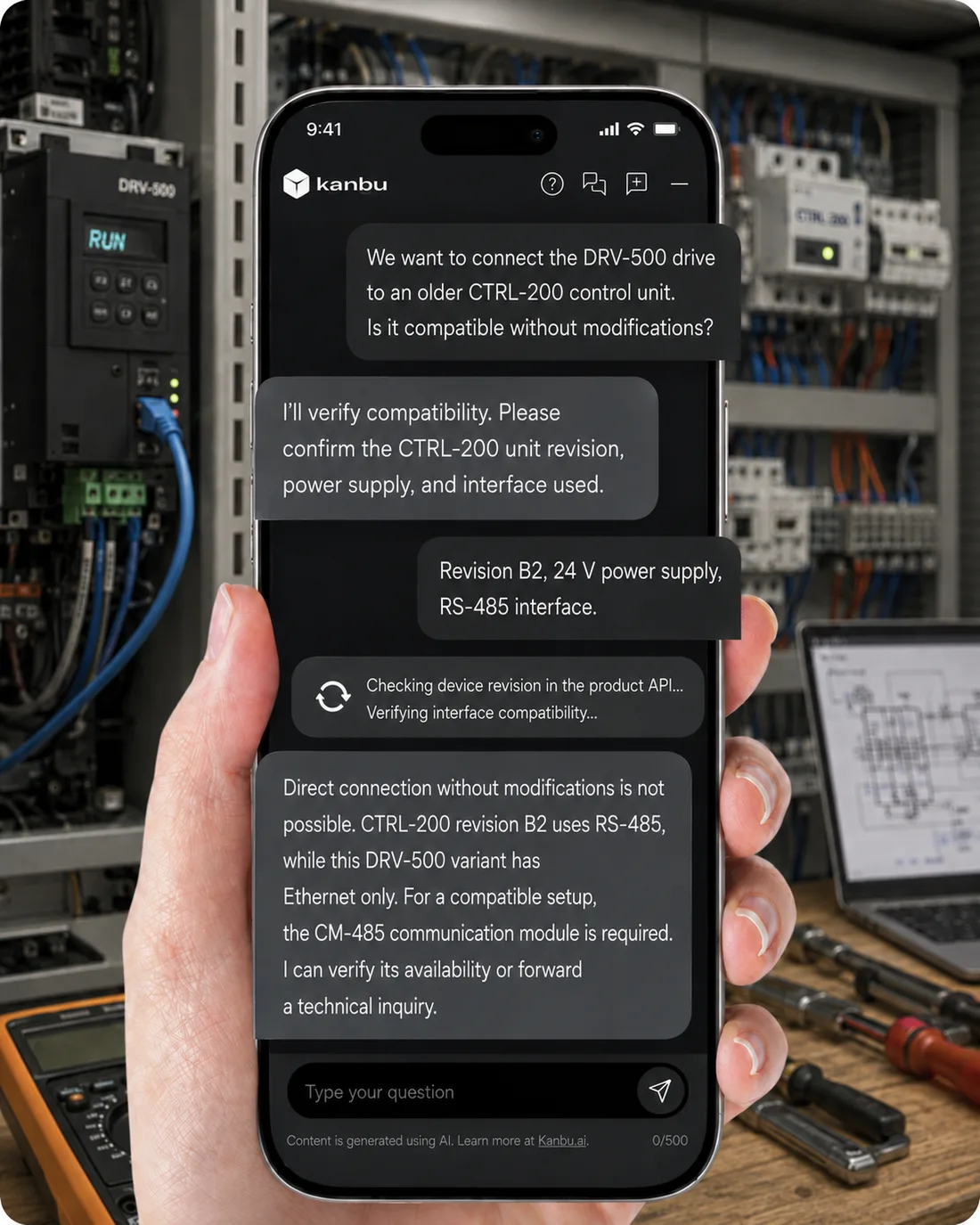
Pre-installation check
Verifies compatibility and prerequisites before installation.
Collects the fault code and serial number from the caller at the machine and creates a service request.
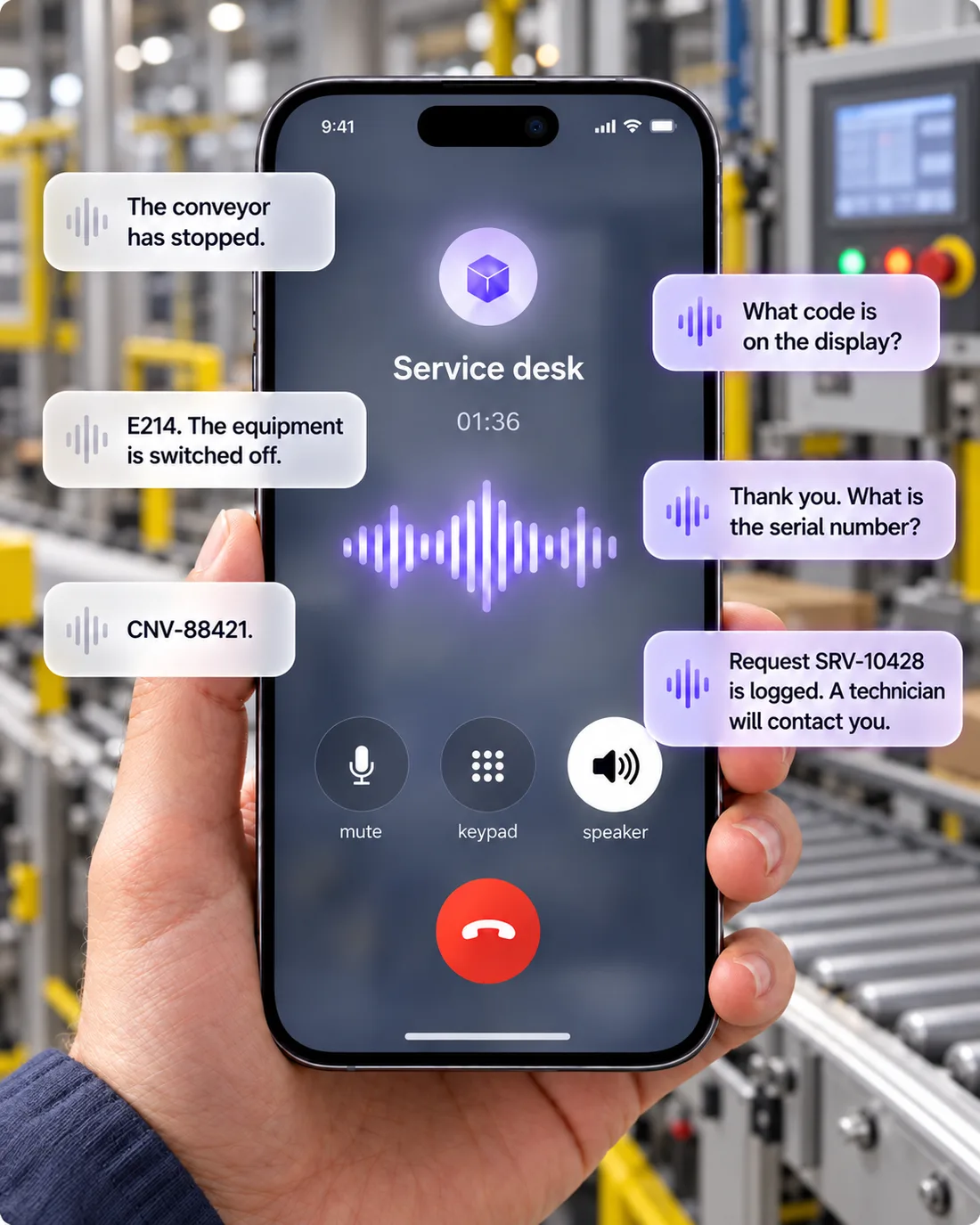
Machine fault by phone
Collects the fault code and serial number from the caller at the machine and creates a service request.
Device selection by parameters
Recommends a suitable device based on technical parameters and use case.
Real deployments
See how Kanbu helps our customers in practice.
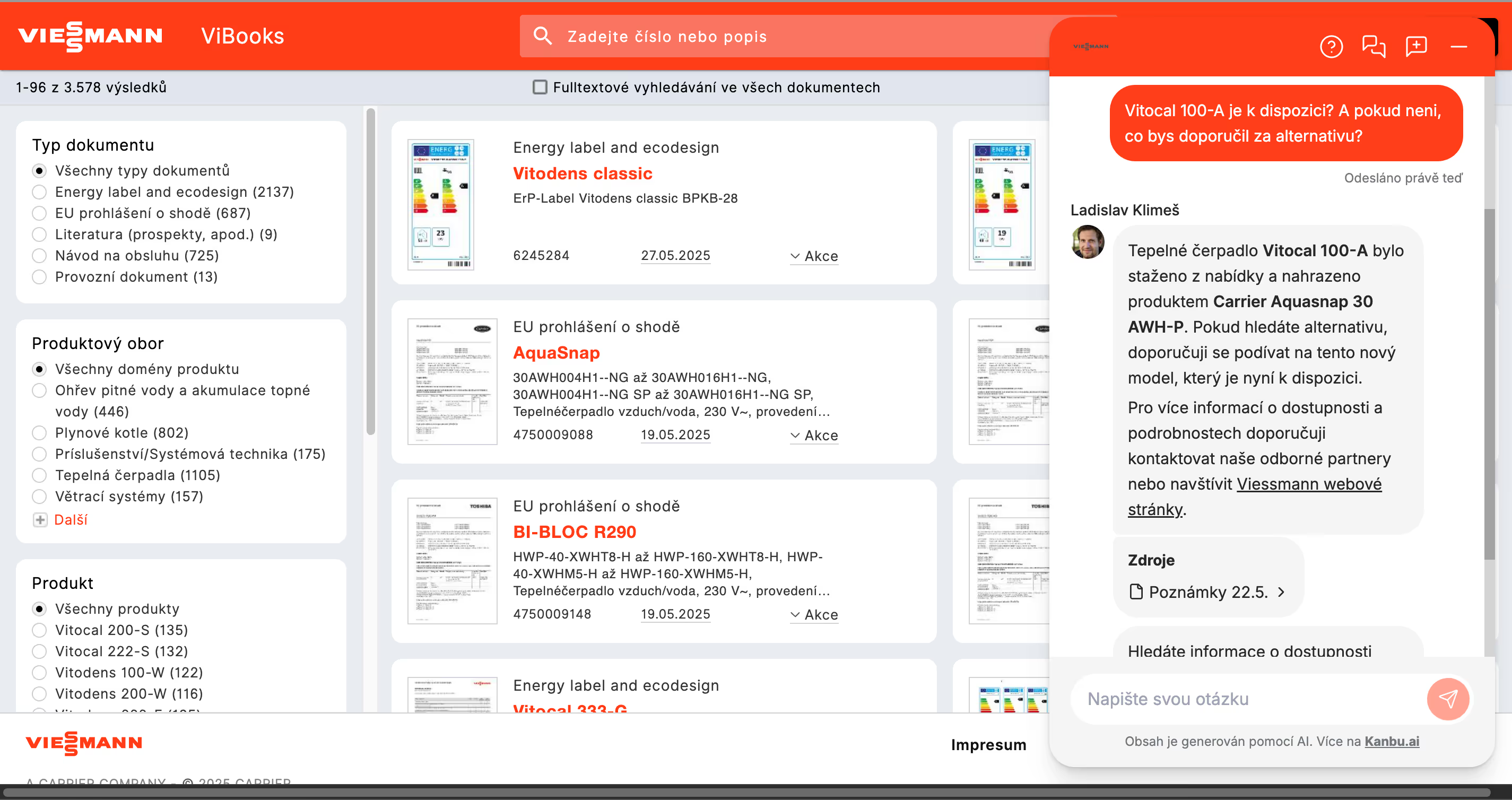
Viessmann
Kanbu.ai helped us make thousands of technical documents accessible through an AI assistant, significantly simplifying navigation through product information.
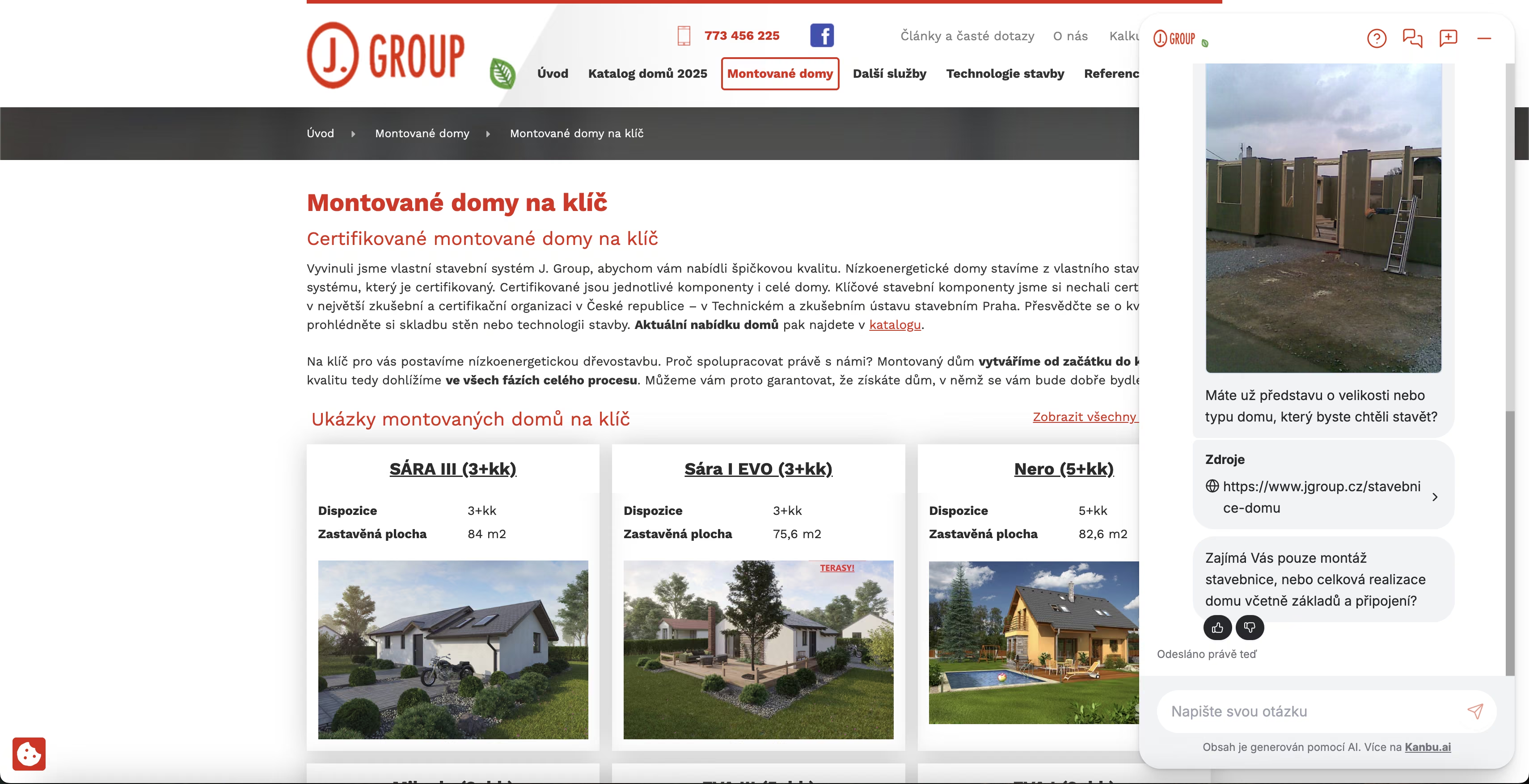
Jgroup
I help answer frequently asked questions about homes, construction, and pricing – making communication with future clients simpler and more efficient.
Example connections
These are examples of connections supported by your systems. Configure API or MCP tools and assign them to the assistant; knowledge sources and product feeds provide content for answers.
Model availability, pricing, serial number, warranty status
Create service request, update repair status
Create inquiry, assign to sales rep, project notes
Datasheets, install procedures, known faults and workarounds
Serial number, application description, desired model, contact
Pass to sales or service technician with the full conversation history
Useful knowledge sources
Keep datasheets and install guides in synced sources. Separate “what the spec sheet says” (knowledge base) from “what I see for the customer in ERP” (API).
- Datasheets, install guides, and certifications
- Warranty terms, service intervals, and maintenance FAQ
- Spare-part price lists and product lines
- Playbooks — explaining technical parameters in plain language
Start with your own content
Choose one recurring question type and prepare approved sources. Test answers against real questions, configure human handover, then add actions in connected systems.
Try the manufacturing assistant
Enter your website URL and in minutes you'll see how I explain technical parameters — with citations to datasheets.